Types of governor | Centrifugal | Intertia |

Governor is known as speed manager OR speed controller. 

They are used in automobile engines to measure and regulate the speed of an engine. It uses gears and flyweights inside the crankcase to detect changes in the load and adjusts the throttle accordingly.

Governor can broadly classify into two types :


  1. Centrifugal governor 
  2. Inertia governor 
Now let us know brief details about these two types of the governor.

  • Centrifugal governor :
This is the most common type of governor. Its action depends on the change in speed. It has a pair of masses, known as governor balls, which rotate with a spindle. The spindle is driven by an engine through bevel gears. 

The action of this governor depends upon the centrifugal effects produced by the governor ball. With the increases in speed, the balls tend to rotate at a greater radius from the axis. This causes the sleeve to slide up on the spindle and this movement of the sleeve is communicated to the throttle through a bell crank lever. This closes the throttle valve to the required extent. When the speed decreases, the governor balls rotate at a smaller radius and the valve is opened according to the requirements. 


Centrifugal governor


Centrifugal governor again classified into two groups :

  • Pendulum type governor :
Pendulum type governor is Watt governor. 

  • Loaded type governor :
Loaded type governor is Porter governor, Proell governor, Hartnell governor, Wilson Hartnell governor, Hartung governor and Pickering governor. 

  • Inertia governor :
In this type of governor, action depends on acceleration. The position of the balls is affected by the forces set up by angular acceleration or deceleration of the given spindle in addition to centrifugal forces on the governor balls. Using suitable linkage and springs, the change in position of the balls is made to open or close the throttle valve. 

Thus, the governor balls are operated by the actual change of engine speed in the case of centrifugal governors, it is by the rate of change of speed in the case of inertia governor. Therefore, the response of inertia governors is faster than that of the centrifugal governor.

Inertia governor

What is mechanical governor | Function | Working

What is the governor?

In simple words, the governor controls engine speed. It uses gears and flyweights inside the crankcase to detect changes in the load and adjusts the throttle accordingly.

The function of a governor?

To maintain the speed of an engine within specified limits whenever there is a variation of load occurs.

How it works?

The governor system is like a cruise control system in an automobile. It maintains the speed of your lawnmower or outdoor power products. 

In general, the speed of an engine varies in two ways, during each revolution and over a number of revolutions. For the first case, it is due to variation in the output torque of the engine during a cycle and can be regulated by mounting a suitable flywheel on the shaft. While in the second case, it is due to variation of the load upon the engine and requires a governor to maintain the speed.

If the load on the shaft increases, the speed of the engine decreases unless the supply of fuel is increased by opening the throttle valve. 

If the load on the shaft decreases, the speed of the engine increases unless the fuel supply is decreased by closing the valve sufficiently to slow the engine to its original speed. 

Thus, the throttle valve is operated by the governor through a mechanism for the purpose. 

Use of governor?

A governor is used to measure and regulate the speed of a machine, such as an engine. It is also called a speed limiter or controller. 

There are two types of governor used in any automobile application. One is centrifugal governor and another is inertia governor. 

What is Unbalance

In simple word, we can say that make someone unsteady so that they fall is called unbalance. 

In theoretical language, the condition which exists in a rotor when vibratory force or motion is imparted to its bearings as a result of centrifugal forces is called unbalance or the uneven distribution of mass about rotor's rotating line.  

Difference between static and dynamic balancing

Balancing of forces is most important in any machinery industries. Unbalance of forces is produced by the inertia forces connected with the moving mass in rotary or reciprocating machinery.

Balancing of a rotating body is done to counter the extra forces in the direction other than the rotation axis helps in avoiding the vibrations in a body.

There are two types of balancing static and dynamic balancing and also have some difference between both types of balancing. Let us have deep insight into the difference between static balancing and dynamic balancing.

Main difference :  

Only forces are balanced in static balancing whereas, in dynamic balancing, both the forces and the couples are balanced.

Difference :

  • Static balancing is performed with the object which is balanced at rest and dynamic balancing is performed with the object being balanced in motion.
  • The static balance will be produced if the sum of weights about the axis of rotation is zero and dynamic balance will be produced there doesn't exist any resultant centrifugal force as well as a resultant couple.
  • Static balancing is done where the centre of gravity is on the axis of rotation of the body while dynamic balancing is done where the body is either rotating about the axis due to an external force or by the change in the centre of gravity of the body.
If we consider balancing whether it is static or dynamic but balancing can help to extend the service life, quality and accuracy of your machine while unbalanced parts can lead to breaking down to your machine.

Dynamic balancing

What is dynamic balancing?

A system is in dynamic balance when there does not exist any resultant centrifugal force and also a resultant couple. 

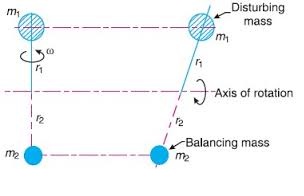
For example Several rotating masses 


When several masses rotate in different planes, the centrifugal forces in addition to being out of balance also from the couple. 

Dynamic balancing

As shown in the figure above the product of mr an mrl usually have been referred to as force and couple respectively as it is more convenient to draw force and couple polygons with these quantities. 

If m1 and m2 are two masses revolving diametrically opposite to each other in different planes such that m1r1 = m2r2.

The centrifugal forces are balanced, but an unbalanced couple of magnitude m1r1l1 = m2r2l2 is introduced. 

The couple acts in a plane that contains the axis of rotation and the two masses. Thus, the couple is of constant magnitude but variable direction. 

Static balancing

Before we start to learn about static balancing you know about balancing. Balancing is the process of designing or modifying machinery so that the unbalance is reduced to an acceptable level and if possible is eliminated entirely. 

What is static balancing?

The combined mass centre of the system lies on the axis of rotation then a system of rotating mass is said to be in static balance.


Static balancing

Explanation of static balancing :

The figure shows a rigid rotor revolving with a constant angular velocity of ω rad/s. A number of masses are depicted by point masses at different radii in the same transverse plane. They may represent different kinds of rotating masses such as turbine blades, eccentric discs etc. 

If m1, m2 and m3 are the masses revolving at radii r1, r2 and r3 respectively in the same the plane, then each mass produces a centrifugal force acting radially outwards from the axis of rotation. 
Let F be the vector sum of these forces.

F = m1r1ω2 + m2r2ω2 + m3r3ω

The rotor is said to be statically balanced if the vector sum F is zero. 

The rotor is said to be unbalanced if vector sum F is not zero. 

Graphical solution :

In graphical solution, vectors, m1r1, m2r2, m3r3 are added. If they close in a loop, the system is balanced. Otherwise, the closing vector will be giving mcrc.

Its direction identifies the angular position of the countermass relative to the other masses. 


Introduction of balancing

Balancing of forces is most important in any machinery industries. Unbalance of forces is produced in rotary or reciprocating machinery due to the inertia forces associated with the moving masses. 

What is balancing?

Balancing is the process of designing or modifying machinery so that the unbalance is reduced to an acceptable level and if possible is eliminated entirely. 

Many serious problems encountered in high-speed machinery are the direct result of unbalanced forces. These forces exerted on the frame by moving machine members are time-varying impact vibratory motion to the frame and produce noise. There are some human discomfort and detrimental effects on machine performance and the structural integrity of the machine foundation. 

The most common approach to balancing is by redistributing the mass which may be accomplished by addition or removal of mass from various machine members. 

There are two basic types of unbalance :
  1. Rotating unbalance
  2. Reciprocating unbalance 
They both occur separately or in combination too. 

There are also two types of balancing system : 
  1. Static balancing 
  2. Dynamic balancing 
If we consider balancing whether it is static or dynamic but balancing can help to extend the service life, quality and accuracy of your machine while unbalanced parts can lead to breaking down to your machine. There is some difference between static and dynamic balancing
 also. 

Advantages of permanent mould casting

Permanent mould casting is a process makes use of a reusable metal mould that made from metal. This process involves pouring molten metal into a mould where cools and solidifies after that mould is opened, casting is removed and mould is reused. Let us have a deep insight into the advantages provided by using this casting process. 

Advantages of permanent mould casting : 

  • Close dimensional tolerance can be obtained. 
  • This process is economical for large scale production as the labour involved in the mould preparation is reduced. 
  • Produce a very good surface finish of the order of 4 microns.
  • Better appearance.
  • This process produces a fine-grained casting with superior mechanical properties because of the metallic mould used.
  • Small cored holes may be produced as compared to sand casting.
  • Inserts can be readily cast in place. 
  • Increases repeatability of casting.
  • Finer grain structure can be obtained.
  • High volume production runs.
  • Less expensive than investment and die casting.
Explore more information:

Advantages and disadvantages of centrifugal casting

Centrifugal casting is the process where molten metal is poured into a mould that is rapidly moving around a fixed axis. The molten metal comes into contact with this rotating mould under a pressure provided by centrifugal force gives better filling of the mould. It is mainly used for making parts having the shape of bodies of revolutions because this process provides very high grain density and porosity is almost zero. Now, let us have a deep insight into some more advantages and disadvantages of this process. 


Advantages of centrifugal casting :

  • The mechanical properties of centrifugally cast jobs are better compared to other processes because the inclusions such as slag and oxides get segregated towards the centre and can be removed by machining. 
  • In the solidification process, the pressure acting on the metal causes the porosity to be eliminated giving rise to dense metal.
  • Up to a certain thickness of objects, proper directional solidification can be obtained starting from the mould surface to the centre. 
  • No cores are required for making concentric holes in the case of true centrifugal castings. 
  • There is no need for gates and runners, which increases the casting yield, reaching almost 100%. 
  • The high output obtained through this casting process.
  • Very huge parts can also be produced up to 61 thousand kgs. 
  • The cylindrical shape can easily be obtained.
  • Good for mass production. 
  • No use of gates and risers. 

Disadvantages of centrifugal casting : 

  • The inner surface of the casting is the inaccurate diameter. 
  • Material limitation, not all alloys can be cast. 
  • Highly skilled workers are required. 
  • High initial cost. 
  • An only certain shape which is axisymmetric and having concentric holes are suitable for true centrifugal casting.
  • Wastage of material is high for this process.
  • This process required careful observations by of professionals.
  • Many other casting processes are better than this process because it is a traditional technique.

Brayton cycle

The Brayton cycle is a thermodynamic cycle that can be invented by George Brayton in 1872.

The Brayton cycle is a type of power cycle that utilizes and ideal gas to generate power from a type of fuel used to heat the air.


What is the Brayton cycle?


In the Brayton cycle, two reversible adiabatic processes and two constant pressure process are done in a heat engine. 


Brayton cycle

Process of Brayton cycle :


The Brayton cycle consist of four processes following below :
  • Adiabatic quasi-static process compression process: In this process compressor takes fresh ambient air and compressed it to a higher temperature and pressure. 
  • Constant pressure heat addition process: In this process, compressed air is sent to the combustion chamber where fuel is burnt at constant pressure. 
  • Adiabatic quasi-static expansion process: High-temperature gases expand to the ambient temperature in the turbine and produce the power.
  • Constant pressure heat rejection process: The exhaust gases leave the turbine and air back to its initial condition.

The efficiency of the Brayton cycle :


In general, the thermal efficiency of the Brayton cycle is defined as the ratio of the work output to the heat input at the high temperature.

ŋth = W / QH

For ideal gas can now we expressed in terms of temperature :

ŋth  = NetWork / Heat Input = WT – WC / Qin

      = cp [ (T3 – T4 ) – (T2 – T1) ] / cp (T3 – T2)

      = 1 – [ (T4 – T1) / (T3 – T2) ]

Where,

WT = Work is done by the gas in the turbine
WC = Work was done on the gas in the compressor
cp = Heat capacity ratio 

Types of chain drive

Chains have been classified into three groups like :

  • Hosting chains
  • Conveyor chains
  • Power-transmission chains 
Each type has been discussed below :

Hosting chains :

Hosting chains include an oval link and stud link chains. An oval-link chain is a common form of a hosing chain. It consists of oval links and is also known as coil chain. 

Hosting chains are used for lower speeds only. 

Conveyor chains :

Conveyor chains may be of the detachable or hook-joint type or of the closed-end pintle type. The sprocket teeth are so shaped and spaced that the chain should run onto the off the sprocket smoothly and without interference. The motion of this type of chain is not very smooth. 

Conveyor chains are used for low-speed agricultural machinery. The material of the links is usually malleable cast iron. 

Power transmission chains :

Power transmission chains are made of steel in which the wearing parts are hardened. They are accurately machined and run on carefully designed sprockets. 

They classified into three types :

  • Blockchain: It is mostly used for transmission of power at low speeds. 

  • Roller chain: Roller chain is fixed to the inner link whereas the outer link has a pin fixed to it. There is only sliding motion between pin and bushing. The roller is made of hardened material and is free to turn on the bushing. A good roller chain is quite and wears less as compared to a blockchain. 

  • Silent chain: It is also known as Inverted Tooth Chain. This type of chain is used where maximum quietness is desired. The silent chain doesn't have rollers. The links are shaped as to engage directly with the sprocket teeth. The included angle is either 60 or 75 degree. 

Law of belting

To transmit power from one shaft to another pulley are mounted on the two shafts. A Belt drive is a mechanism in which power is transmitted by the movement of a continuous flexible belt. 

so now let us check it out some information of how to belt drive works? to know more about the law of belting. 

The law of belting states that the centre line of the belt when it approaches a pulley must lie in the midplane of that pulley OR A pulley in that plane must contain the point at which the belt leaves the other pulley. However, when a belt leaving a pulley may be drawn out of the plane of the pulley. 


Law of belting


By following this law of belting, non-parallel shafts may be connected by a flat belt. From the above figure, two shafts with two pulleys are at right angles to each other. Both of these can be observed that the centre line of the belt approaching the larger pulley and it lies in its plane which is also true for the smaller pulley. Also, the points at which the belt leaves a pulley are contained in the plane of the other pulley. 

By observation, it should not possible to operate the belt in the reverse direction without violating the law of belting. Thus, for non-parallel shafts, motion is possible only in one direction. Otherwise, the belt is thrown off the pulley. However, it is possible to run a belt in either direction on the pulleys of two intersecting or two non-parallel shafts with the help of guide pulleys. Thus, the law of belting is still satisfied. 

Greasy friction

If two metallic surfaces are wetted with a small amount of lubricant, a very thin film of the same is formed on each of the surfaces. This thin film is of molecular thickness. It adheres to the surface and is known as absorbed film. 

The property of a lubricant to form a layer of molecular thickness on a metallic surface is known as its oiliness. 

If two lubricants of equal viscosity are used to lubricate two metallic surfaces under identical conditions, it is found that one reduces the friction more than the other and is said to have greater oiliness. 

Now, What is Greasy friction?

The friction of two surfaces, when they are wetted with an extremely thin layer of lubricant and metal-to-metal contact can take place between high spots is known as greasy friction or boundary friction. 

The friction laws governing greasy friction are similar to those for solid or dry friction. 

Laws of friction

There are total five basic laws of friction so now let we check it out one by one.

Experiments have shown that the force of solid friction 

  • is directly proportional to the normal reaction between the two surfaces.
  • opposes the motion between the surfaces.
  • depends upon the materials of the two surfaces.
  • is independent of the area of contact.
  • is independent of the velocity of sliding.
The last of these five laws is not true in the strict sense as it has been found that the friction force decreases slightly with the increase in velocity. 

Types of follower motion

Though the follower can be made to have any type of desired motion, knowledge of existing motion program saves time and labour while designing the cams.

Following are some basic displacement programmes :

  1. Simple Harmonic Motion ( SHM )
  2. Constant Acceleration Deceleration ( Parabolic )
  3. Constant Velocity 
  4. Cycloidal 

Mechanical advantage definition

What is a mechanical advantage?

The ratio of the output force or torque to the input force or torque at any instant OR 
The ratio of force produced by a machine to the force applied to it is called the mechanical advantage of mechanism. 

For any linkage, if friction and inertia forces are ignored and the input torque is applied on one link and resisting torque is on another link then formula for finding mechanical advantage :


Power input = Power output 

 T1w1 = T2w2

So, Mechanical Advantage = T1/T2 = w1/ w2

Thus mechanical advantage is written as the reciprocal of the velocity ratio or the reciprocal of the torque ratio.  

What is moment of a force

The general definition of the moment of force :

Moment of force is defined as a product of force and the moment arm. Now the question arise in your mind that what is moment arm? The moment arm is the perpendicular distance between the line of action of the force and the centre of moments. 

In mechanics moment of force is turning effect produced by force, on a body, on which it acts. 

Moment of force = Force applied × Perpendicular distance from the fixed axis. This formula is applied to calculate the moment of force for balanced as well as unbalanced forces. 


Moment of a force

In the above figure the moment of force = ( P × l ) N-m

If the force is in Newton and moment of force is in meter then the unit of moment of force is Newton-meter ( N-m ).


Lami theorem is applicable only for

Application of Lami's theorem :

Lami's theorem is used to describe an equilibrium of three forces but not for more forces. 

It isn't much used any more since the development of vector algebra in the 1900s. 

Lami's theorem applicable to more than three forces by resolving the system into 3 forces and make sure that none of the three angles is greater than 180°.

Lami's Theorem

Lami's theorem is related to the system of forces like the magnitude of three coplanar, concurrent and non-colinear forces that keeps a body in static equilibrium. 

Lami's theorem statement :


It is stated that if three coplanar forces acting at a point be in equilibrium, then each force is proportional to the sine of the angle between the other two forces. 


Lami's Theorem

Now we consider the three forces A, B and C acting on a particle or rigid body that all forces making respective angles α, β and γ with each other.


Now we can represent the Lami's theorem in mathematically :


A / sinα = B / sinβ = C / sinγ


You also check it out the Lami theorem is applicable only for what type of applications.

System of forces

When a mechanics problem or system has more than one force act on a body, it is known as a system of force OR Force system.

There is a various system of forces following below :
1. Coplanar forces: The forces, whose line of action lie on the same plane that is known as coplaner forces. 

There are four types of coplanar forces system :
  • Collinear force system: When the lines of action of all the forces of a system act along the same line, this force system is called collinear force system.
  • Parallel force system: When the line of action of all the forces of a system is different and parallel to each other, this force system is called a parallel force system. 
  • Concurrent force system: When the forces extended and it passes through a single point this system is called the concurrent force system.  
The point is called the point of concurrency. The lines of actions of all forces meet at the point of concurrency. 
Concurrent forces may or may not be coplanar.

  • Non-concurrent force system: In the system, all the forces do meet at a common point of concurrency, this force system is called non-concurrent force system. 

Parallel forces are an example of this type of force system. 
Non-concurrent forces may be coplanar or non-coplanar.

2. Non-coplanar forces: The forces, whose line of action don't lie on a single plane is called non-coplanar forces or Space forces. 

There is three non-coplanar force system :
  • Parallel force system: When the line of action of all the forces of a system is different and parallel to each other and also both are in a different plane, this force system is called parallel force system. 
  • Non-coplanar concurrent forces: When all the forces in the system meet at one point but their lines of action don't lie on the same plane that type of system is known as non-coplanar concurrent forces.
  • Non-coplanar non-concurrent forces : The forces that are not meet at one point and their lines of actions do not lie on the same plane are called non-coplanar non-concurrent forces.