Chemical structure of petroleum

Petroleum, as obtained from the oil wells, is predominantly a mixture of many hydrocarbons with differing molecules structure. It also contains a small amount of sulphur, oxygen, nitrogen and impurities such as water and sand. 

The carbon-hydrogen atoms may be linked in different ways in a hydrocarbon molecule and this linking influences the chemical and physical property of different hydrocarbon groups. Most petroleum fuels tend to exhibit the characteristics of that type of hydrocarbon which forms a major constituent of the fuel. 

The carbon and hydrogen combine in different proportions and molecular structure to form a variety of hydrocarbons. The carbon to hydrogen ratio which is one of the important parameters and their nature of bonding determine the energy characteristics of the hydrocarbon fuels. Depending upon the number of carbon and hydrogen atoms the petroleum product is classified into different groups. 

The differences in physical and chemical properties between different types of hydrocarbon depend on the chemical composition and affect mainly the combustion process and hence, the proportion of fuel and air required in the engine. The basic families of hydrocarbons, their general formula and their molecular arrangement are shown below :

1. Paraffin :
  • General formula: CnH2n+2
  • Molecular structure: Chain 
  • Saturated / Unsaturated : Saturated 
  • Stability: Stable 
2. Olefin :
  • General formula: CnH2n
  • Molecular structure: Chain 
  • Saturated / Unsaturated : Unsaturated 
  • Stability: Unstable 
3. Naphthene :
  • General formula: CnH2n
  • Molecular structure: Ring 
  • Saturated /Unsaturated: Highly saturated 
  • Stability: Most stable 
4. Aromatic : 
  • General formula: CnH2n-6
  • Molecular structure: Ring 
  • Saturated / Unsaturated : Unsaturated 
  • Stability: Unstable 

Classification of fuels | Fuel and its classification

The fuel can be classified mainly into three types one is a liquid fuel, the second one is gaseous fuel and another one is a solid fuel. Based on the type of fuel used by engines are classified as follows. Let us check out the detailed information on the classification of fuels here in this article. 

Classification of fuels: 

  • Engine using volatile liquid fuels for example - gasoline, alcohol, kerosene, benzene etc. The fuel is generally mixed with air to form a homogeneous charge in a carburettor outside the cylinder and drawn into the cylinder in its suction stroke. By an externally applied spark, the charge is ignited near the end of the compression stroke. These engines are called spark-ignition engines. 
  • Engine using gaseous fuels like CNG full form Compressed Natural Gas, LPG full form Liquefied Petroleum Gas, blast furnace gas and biogas. Gaseous fuels are comparatively better compared to liquid fuels because of reduced ignition delay. The gas is mixed with air and the mixture is introduced into the cylinder during the suction process. The working of this type of engine is similar to that of the engines using liquid fuels called SI gas engines.
  • Engine using solid fuels like charcoal, powdered coal etc. Solid fuels are generally converted into gaseous fuels outside the engine in a separate gas producer and the engine works as a gas engine. 
  • Engine using viscous liquid fuels like heavy and light diesel oils. The fuel is generally introduced into the cylinder in the form of minute droplets by a fuel injection system near the end of the compression process. Combustion takes place because of the fuels coming into contact with the high temperature compressed air in the cylinder. Therefore, these engines are called compression-ignition engines. 
  • Engines using two fuels. A gaseous fuel or a highly volatile liquid fuel is supplied along with air during the suction stroke or during the initial part of compression through a gas valve in the cylinder head and the other fuel is injected into the combustion space near the end of the compression stroke. These are called dual-fuel engines.  

Definition of heat engine

What is a heat engine?

In thermodynamics and engineering a device for producing motive power from heat. 

A heat engine is a system that converts thermal and chemical energy into mechanical energy which can be used to do mechanical work.  

Heat engine can be classified into two categories :

  1. Internal combustion engine 
  2. External combustion engine

Engines are also classified into two types :

  1. Rotary engines 
  2. Reciprocating engines 

Definition of Engine

What is the engine?

A machine that converts any of various form of energy into mechanical force and motion. 

A mechanism which can serve as an energy source. 

Normally, most the engines convert thermal energy into mechanical work and therefore they are called Heat Engine. 

The engine can be broadly classified into two categories :

  1. Internal combustion engine
  2. External combustion engine 

Difference between spontaneous and stimulated emission

What is called spontaneous emission?

Spontaneous emission is electron drops from an excited state to a lower state. 

Example - emitting a photon.

What is called stimulated emission?

Stimulated emission is a photon of the same frequency that interacts with an electron in an excited state which drops to a lower state. The emitted photon is coherent with the incoming photon.

Example - Laser 

Let us have deep insight into the difference between spontaneous and stimulated emission to know more about this concept. 

Differences between spontaneous and stimulated emission :

  • Where quantum system undergoes a change and jumps to a lower energy state, emitting quanta of energy is called the spontaneous emission Whereas stimulated emission is the process where an external photon of a certain frequency, reacts with the excited electron in an atom and this results in dropping to lower energy state.
  • Spontaneous emission found in LEDs, Fluorescent tubes and stimulated emission found in laser it is the key process for the formation of a laser beam. 
  • There is no population inversion of electrons in LEDs in spontaneous emission whereas population inversion is achieved by various pumping techniques in stimulated emission. 
  • In spontaneous emission, external stimuli are not required and stimulated emission is caused by external stimuli. 
  • Spontaneous emission depends only on the upper level of the electron whereas stimulated emission depends upon the electron being in the upper level but the electron must be started at the upper level. 
  • Only one energy wave is released during spontaneous emission while two energy waves are released during stimulated emission. 
  • Spontaneous emission is the self-emission process of radioactive materials without any influence of radiation whereas a single particle or group of particles initiated emission in radioactive material is called stimulated emission.

Stimulated emission

The concept of stimulated emission was first put forward by Albert Einstein in 1917.

Let us consider two energy levels E1 and E2 in a material. Let us assume that the atom is initially at energy level E2. Also, consider that an electromagnetic wave of frequency v is incident on a given material. This wave has the same frequency as that of the specific material. Therefore, there is a high degree of probability that this wave will force the atom to undergo a change from energy level E2 to energy level E1. In this case, the energy difference E2 - E1 is received in the form of an electromagnetic wave which adds to the incident wave. Here, it is to be noted that the atom is already in the excited state E2. Before it could come to the ground state, due to the spontaneous emission process, if it is irradiated with a photon, whose energy is exactly equal to E2 - E1. The incident photon will stimulate the excited atom to emit one photon of exactly the same energy, as that of the incident photon. Thus, two photons will be emitted in this process. This phenomenon is known as Stimulated Emission. 


Stimulated emission

Note: The most remarkable feature of the stimulated emission is both the emitted photons will have the same frequency, phase direction and polarization, as that of the incident photon. So, in this process, we give the input of one incident photon and obtain the two photons identical in all respects as an output. Thus, amplification of radiation takes place by the stimulated process. 

Spontaneous emission


Let us consider two energy levels E1 and E2 in a material. For convenience, E1 is taken to be the ground level. E2 is greater than E1. ( E2 > E1 ) The two levels of energy under consideration can be any two of the unlimited numbers of levels of energy that can be possessed by any material. 

E1 = Energy level 1 ( Ground state )
E2 = Energy level 2 ( Excite state ) 
h = Plank's constant
v = Frequency of radiated energy 

Spontaneous emission

When the particle or atom of the material is excited, it can remain in the excited state for a limited time known as a lifetime. The lifetime of the excited hydrogen atoms is of the order of 10-8 sec. Usually, the number of excited particles in a system is smaller than the non-excited particles. The time during which a particle can exist in the ground state is unlimited. The particle at the excitement level is more unstable as compared to that at the ground level. Naturally, there is a tendency for the particle to come back to ground level. When it comes back to ground level, the particle releases some amount of energy. When this energy is released in the form of electromagnetic waves, we call it spontaneous emission of energy. The frequency of the radiated wave is given by :

v = ( E2 - E1 / h ) 
OR 
hv = ( E2 - E1

Note: Radiative emission is just one of the two possible ways for the atom to decay. The decay can also occur in a non-radiative manner. In the non-radiative transition, the difference in energy levels E2 and E1 can be experienced in regions other than electromagnetic. 

Types of mechanical vibration

There are mainly three basic types of vibration according to the axis of body move : 

  1. Longitudinal vibration 
  2. Transverse vibration 
  3. Torsional vibration 
Now we can check it out in detail below. Let us check out the different types of mechanical vibration here in this article. Before you start you can check some basic introduction of mechanical vibration

  • Longitudinal vibration :
If the shaft is elongated and shortened so that the same moves up and down resulting in tensile and compressive stresses in the shaft, the vibrations are said to be longitudinal. The different particles of the body move parallel to the axis of the body. 

  • Transverse vibration :
When the shaft is bent alternately and tensile and compressive stresses due to bending result, the vibrations are said to be transverse. The particles of the body move approximately perpendicular to its axis. 

  • Torsional vibration :
When the shaft is twisted and untwisted alternately and torsional shear stresses are induced, the vibrations are known as torsional vibrations. 

There are also some more vibrations that are following below :
  1. Free and Forced vibration 
  2. Linear and non-linear vibration 
  3. Damped and Un-damped vibration 
  4. Deterministic and Random vibration 
Now we can check it out in detail below : 

  • Free vibration : 
After distributing the system, the external excitation is removed, then the system vibrates on its own. This type of vibration is known as free vibration. 

Example - Simple pendulum 

  • Forced vibration 
The vibration which is under the influence of external force is called forced vibration. 

Example - Machine tools, electric bells

  • Linear vibration : 
In a system, if mass, spring and damper behave in a linear manner, the vibrations caused are known as linear in nature. 

They are governed by linear differential equations. 
They follow the law of superposition. 

  • Non-linear vibration : 
If any of the basic components of a vibratory system behaves non-linearly that type of vibration is called non-linear in nature. 

Linear vibration becomes non-linear for a very large amplitude of vibrations. 
They do not follow the law of superposition. 

  • Damped and Un-damped vibration : 
If the vibratory system has a damper and the motion of the system will be opposed by the damper also the energy of the system will be dissipated in friction is called damped vibration. 

On the other hand, the system that has no damper is known as un-damped vibration. 

  • Deterministic and Random vibration :
In the vibratory system, the amount of external excitation is known in magnitude, it causes deterministic vibration is called deterministic vibration.

The non-deterministic vibration is known as random vibrations. 


Introduction to mechanical vibration

A body is said to vibrate if it has a to and fro motion. A pendulum swinging on either side of a mean position does so under the action of gravity. When the pendulum swings through the mid position, its centre of mass is at the lowest point and it possesses only kinetic energy. At each extremity of its swing, it has only potential energy. In the absence of any friction, the motion continues indefinitely. It can be shown that if the swings on either side of the mean position are very small, it approximates to simple harmonic motion. 

Usually, vibrations are due to elastic forces. Work is done on the elastic constraints of the forces on the body when a body is displaced from its equilibrium position and is stored as strain energy. Now, if the body is released, the internal forces cause the body to move towards its equilibrium position. If the motion is frictionless, the strain energy stored in the body is converted into kinetic energy during the period the body reaches the equilibrium position at which it has maximum kinetic energy. The body passes through the mean position, the kinetic energy is utilized to overcome the elastic forces and is stored in the form of strain energy. 

The vibration is mainly three types :

  1. Longitudinal vibrations
  2. Transverse vibrations
  3. Torsional vibrations 
Terms related to vibration :
  1. Free vibration 
  2. Damped vibration 
  3. Forced vibration 
  4. Period
  5. Cycle
  6. Frequency 
  7. Resonance 
All the terms are used in vibrations are explain below :

Free vibration is also called natural vibration. Elastic vibration in which there are no friction and external forces after the initial release of the body is known as free vibration.

Damped vibrations are when the energy of a vibrating system is gradually dissipated by friction and other resistances is called damping. The vibrations gradually cease and the system rests in its equilibrium position.

Forced vibration is when a repeated force continuously acts on a system. The vibration is said to be forced. The frequency of the vibrations is that of the applied force and is independent of their own natural frequency of vibrations. 

The period is the time taken by a motion to repeat itself and is measured in seconds. 

The cycle is the motion completed during one time period. 

Frequency is the number of cycles of motion completed in one second. It is expressed in hertz ( Hz ) and is equal to one cycle per second. 

Resonance is the frequency of the external forces is the same as that of the natural frequency of the system. 
A state of resonance is said to have been reached. 

It results in large amplitudes of vibrations and this may be dangerous. 


Explore more information: 

Watt governor application

Let us check out the Watt governor application here in this article. 

Application of Watt governor:

  • Watt governor used to maintain the engine's speed of the truck.
  • It is also used in ships and trains.
  • It is used in a steam turbine, the internal combustion engine and variously fueled turbines. 
  • Watt governor is also used in AC generators to maintain the electricity supply with the load increase on it. 
  • It is used in automobiles to restrict engine RPM and total speed. 
  • It also protects the engine from excessive rotational speed.
  • We also used it in that system where working fluid and speed of the system are the main issues. 

Watt governor | Working | Limitations | Height calculation

Watt governor is the simplest form of a centrifugal governor. It is also called a simple conical pendulum governor. It is basically a conical pendulum with a link attached to a sleeve of negligible mass. This governor is used by James Watt in his steam engine and it also has many applications. 

Working of Watt governor :


The upper sides of arms are pivoted with the governor balls so the governor balls can move upward and downward as they revolve with a vertical spindle. Bevel gears drive the engine. A bevel gear is driven by the spindle. The lower arms are connected to the sleeves and are keyed to the spindle in such a way that revolves around the spindle. At that time, it can slide up and down according to the spindle speed. Two stoppers are provided at the bottom and top of the spindle to limit the movement of the sleeve.


If the load on the engine decreases, the speed of the engine and then the angular velocity of the governor spindle increase. The centrifugal force on the ball increases that tends balls to move outward and the sleeve to move upward thus sleeve actuates a mechanism that operates the throttle valve at the end of the bell crank lever to decrease the fuel supply. Thus the power output is reduced.


If the speed of the engine decreases as the load on the engine increase, the centrifugal force decreases. So that the inward movement fly balls and downward movement of the sleeve cause a wide opening of the throttle valve. Engine speed increase with increasing the fuel supply.


Types of Watt governor :

The Watt governor was classified based on the position of upper arms. The arms can be connected by the way we describe below :

  1. Pivot is on the axis of the spindle 
  2. Pivot is offset from spindle
  3. The pivot is offset, and arms cross the axis.
Based on this Watt governors are classified into three types :
  1. Simply pinned type governor 
  2. Open arm type governor 
  3. Crossed arm type governor 
Simply pinned type governor: The upper arms are joined to a point O on the axis of the spindle, where both arms intersect the spindle axis.

Open arm type governor:
 The upper arm of Watt governor is hinged on a collar attached to the spindle or joined by a horizontal link as shown in fig below i
nstead of connecting directly to the spindle. The arms, when produced, meet the axis of the spindle at O. 

Crossed arm type governor:
 The upper arms o governor in hinged on a collar on the axis of the spindle or arms are joined through a fixed horizontal link as shown in fig below. The arms intersect the axis at a point O.


Watt governor


Limitations of Watt governor :
  • Its use is limited up to vertical position applications. 
  • It is used in a very slow speed engines because, at a higher speeds, the sensitivity of the governor will decrease. 
Height Calculations :

The vertical distance from the plane of rotation of the balls to the point of intersection of the upper arms along the axis of the spindle is called the height of the governor. 

The height of the governor decreases with an increase in speed and increases with a decrease in speed. 

Let, 
m = mass of each ball
h = height of governor
w = weight of each ball ( w = mg )
ω = angular velocity of the balls, arms and the sleeve
T = Tension in the arm
r = radial distance of ball-centre from spindle-axis 

For the finding h, the height of governor the equilibrium of the mass provides 

Tcosθ = mg and Tsinθ = mrω2
Tanθ = mrω2 / mg = rω2 / g
r / h = rω2 / g
h = g / ω2 = g / ( 2πN / 60 ) = ( 60 / 2π )2 * 9.81 / N2
h = 859 / N2 m
h = 859000 / N2 mm

Thus, the height of a Watt governor is inversely proportional to the square of the speed. 

Explore more information: 

Hunting of governor | Definition | Process

Definition of hunting of governor:

You know that the function of the governor is to keep the speed constant so the hunting of a governor is the condition in which the speed of the engine can fluctuate continuously above and below the mean speed and which are controlled by the governor.

In other words, hunting is said to occur in a governor when it is not able to find a stable position for a change in load at a new value of speed and oscillates around it due to the tendency of balls and sleeve to restore original speed and inertia effect leading to an overshoot of the desired position.

Process of hunting:

The sensitiveness of a governor and the hunting of a governor both are desirable qualities. If a governor is too sensitive, it may fluctuate continuously, because when the load on the engine falls, the sleeve rises rapidly to a maximum position. This shuts off the fuel supply to the extent of effect a sudden fall in speed. As the speed falls below the mean value, the sleeve again moves rapidly and falls to a minimum position to increase the fuel supply. The speed subsequently rises and becomes more than the average with the result that the sleeve again rises to reduce the fuel supply. This process is continuing and it is known as hunting of the governor. 

Hunting is directly proportional to sensitiveness. If more sensitive the governor, more is the hunting.

Sensitiveness of governor | Definition | Formula

Definition of sensitiveness : 

The ratio of the difference between the maximum and minimum equilibrium speed to the mean equilibrium speed is called sensitiveness of governor.

A governor is said to be sensitive when it readily responds to a small change of speed. The movement of the sleeve for a fractional change of speed is the measure of sensitivity. 

Explanation of sensitiveness :

As a governor is used to limit the change of speed of the engine between minimum to full-load conditions, the sensitiveness of a governor is also defined as the ratio of the difference between the maximum and the minimum speeds to the mean equilibrium speed. 

Sensitiveness = Range of speed / Mean speed 

                       = N2 - N1 / N 
                       
                       = 2 ( N2 - N1 ) / N1 + N2 

Where, 

N = Mean speed
N1 = Minimum speed corresponding to full load condition 
N2 = Maximum speed corresponding to no-load condition 


Types of governor | Centrifugal | Intertia |

Governor is known as speed manager OR speed controller. 

They are used in automobile engines to measure and regulate the speed of an engine. It uses gears and flyweights inside the crankcase to detect changes in the load and adjusts the throttle accordingly.

Governor can broadly classify into two types :


  1. Centrifugal governor 
  2. Inertia governor 
Now let us know brief details about these two types of the governor.

  • Centrifugal governor :
This is the most common type of governor. Its action depends on the change in speed. It has a pair of masses, known as governor balls, which rotate with a spindle. The spindle is driven by an engine through bevel gears. 

The action of this governor depends upon the centrifugal effects produced by the governor ball. With the increases in speed, the balls tend to rotate at a greater radius from the axis. This causes the sleeve to slide up on the spindle and this movement of the sleeve is communicated to the throttle through a bell crank lever. This closes the throttle valve to the required extent. When the speed decreases, the governor balls rotate at a smaller radius and the valve is opened according to the requirements. 


Centrifugal governor


Centrifugal governor again classified into two groups :

  • Pendulum type governor :
Pendulum type governor is Watt governor. 

  • Loaded type governor :
Loaded type governor is Porter governor, Proell governor, Hartnell governor, Wilson Hartnell governor, Hartung governor and Pickering governor. 

  • Inertia governor :
In this type of governor, action depends on acceleration. The position of the balls is affected by the forces set up by angular acceleration or deceleration of the given spindle in addition to centrifugal forces on the governor balls. Using suitable linkage and springs, the change in position of the balls is made to open or close the throttle valve. 

Thus, the governor balls are operated by the actual change of engine speed in the case of centrifugal governors, it is by the rate of change of speed in the case of inertia governor. Therefore, the response of inertia governors is faster than that of the centrifugal governor.


Inertia governor

What is mechanical governor | Function | Working

What is the governor?

In simple words, the governor controls engine speed. It uses gears and flyweights inside the crankcase to detect changes in the load and adjusts the throttle accordingly.

The function of a governor?

To maintain the speed of an engine within specified limits whenever there is a variation of load occurs.

How it works?

The governor system is like a cruise control system in an automobile. It maintains the speed of your lawnmower or outdoor power products. 

In general, the speed of an engine varies in two ways, during each revolution and over a number of revolutions. For the first case, it is due to variation in the output torque of the engine during a cycle and can be regulated by mounting a suitable flywheel on the shaft. While in the second case, it is due to variation of the load upon the engine and requires a governor to maintain the speed.

If the load on the shaft increases, the speed of the engine decreases unless the supply of fuel is increased by opening the throttle valve. 

If the load on the shaft decreases, the speed of the engine increases unless the fuel supply is decreased by closing the valve sufficiently to slow the engine to its original speed. 

Thus, the throttle valve is operated by the governor through a mechanism for the purpose. 

Use of governor?

A governor is used to measure and regulate the speed of a machine, such as an engine. It is also called a speed limiter or controller. 

There are two types of governor used in any automobile application. One is centrifugal governor and another is inertia governor. 

What is Unbalance

In simple word, we can say that make someone unsteady so that they fall is called unbalance. 

In theoretical language, the condition which exists in a rotor when vibratory force or motion is imparted to its bearings as a result of centrifugal forces is called unbalance or the uneven distribution of mass about rotor's rotating line.  

Difference between static and dynamic balancing

Balancing of forces is most important in any machinery industries. Unbalance of forces is produced by the inertia forces connected with the moving mass in rotary or reciprocating machinery.

Balancing of a rotating body is done to counter the extra forces in the direction other than the rotation axis helps in avoiding the vibrations in a body.

There are two types of balancing static and dynamic balancing and also have some difference between both types of balancing. Let us have deep insight into the difference between static balancing and dynamic balancing.

Main difference :  

Only forces are balanced in static balancing whereas, in dynamic balancing, both the forces and the couples are balanced.

Difference :

  • Static balancing is performed with the object which is balanced at rest and dynamic balancing is performed with the object being balanced in motion.
  • The static balance will be produced if the sum of weights about the axis of rotation is zero and dynamic balance will be produced there doesn't exist any resultant centrifugal force as well as a resultant couple.
  • Static balancing is done where the centre of gravity is on the axis of rotation of the body while dynamic balancing is done where the body is either rotating about the axis due to an external force or by the change in the centre of gravity of the body.
If we consider balancing whether it is static or dynamic but balancing can help to extend the service life, quality and accuracy of your machine while unbalanced parts can lead to breaking down to your machine.

Dynamic balancing

What is dynamic balancing?

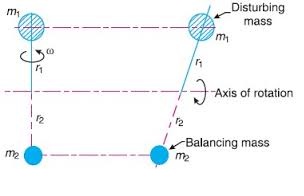
A system is in dynamic balance when there does not exist any resultant centrifugal force and also a resultant couple. 

For example Several rotating masses 


When several masses rotate in different planes, the centrifugal forces in addition to being out of balance also from the couple. 

Dynamic balancing

As shown in the figure above the product of mr an mrl usually have been referred to as force and couple respectively as it is more convenient to draw force and couple polygons with these quantities. 

If m1 and m2 are two masses revolving diametrically opposite to each other in different planes such that m1r1 = m2r2.

The centrifugal forces are balanced, but an unbalanced couple of magnitude m1r1l1 = m2r2l2 is introduced. 

The couple acts in a plane that contains the axis of rotation and the two masses. Thus, the couple is of constant magnitude but variable direction. 

Static balancing

Before we start to learn about static balancing you know about balancing. Balancing is the process of designing or modifying machinery so that the unbalance is reduced to an acceptable level and if possible is eliminated entirely. 

What is static balancing?

The combined mass centre of the system lies on the axis of rotation then a system of rotating mass is said to be in static balance.


Static balancing

Explanation of static balancing :

The figure shows a rigid rotor revolving with a constant angular velocity of ω rad/s. A number of masses are depicted by point masses at different radii in the same transverse plane. They may represent different kinds of rotating masses such as turbine blades, eccentric discs etc. 

If m1, m2 and m3 are the masses revolving at radii r1, r2 and r3 respectively in the same the plane, then each mass produces a centrifugal force acting radially outwards from the axis of rotation. 
Let F be the vector sum of these forces.

F = m1r1ω2 + m2r2ω2 + m3r3ω

The rotor is said to be statically balanced if the vector sum F is zero. 

The rotor is said to be unbalanced if vector sum F is not zero. 

Graphical solution :

In graphical solution, vectors, m1r1, m2r2, m3r3 are added. If they close in a loop, the system is balanced. Otherwise, the closing vector will be giving mcrc.

Its direction identifies the angular position of the countermass relative to the other masses. 


Introduction of balancing

Balancing of forces is most important in any machinery industries. Unbalance of forces is produced in rotary or reciprocating machinery due to the inertia forces associated with the moving masses. 

What is balancing?

Balancing is the process of designing or modifying machinery so that the unbalance is reduced to an acceptable level and if possible is eliminated entirely. 

Many serious problems encountered in high-speed machinery are the direct result of unbalanced forces. These forces exerted on the frame by moving machine members are time-varying impact vibratory motion to the frame and produce noise. There are some human discomfort and detrimental effects on machine performance and the structural integrity of the machine foundation. 

The most common approach to balancing is by redistributing the mass which may be accomplished by addition or removal of mass from various machine members. 

There are two basic types of unbalance :
  1. Rotating unbalance
  2. Reciprocating unbalance 
They both occur separately or in combination too. 

There are also two types of balancing system : 
  1. Static balancing 
  2. Dynamic balancing 
If we consider balancing whether it is static or dynamic but balancing can help to extend the service life, quality and accuracy of your machine while unbalanced parts can lead to breaking down to your machine. There is some difference between static and dynamic balancing
 also.